Cognitive Hegemony: The Reordering of Global Power in the Era of Compute
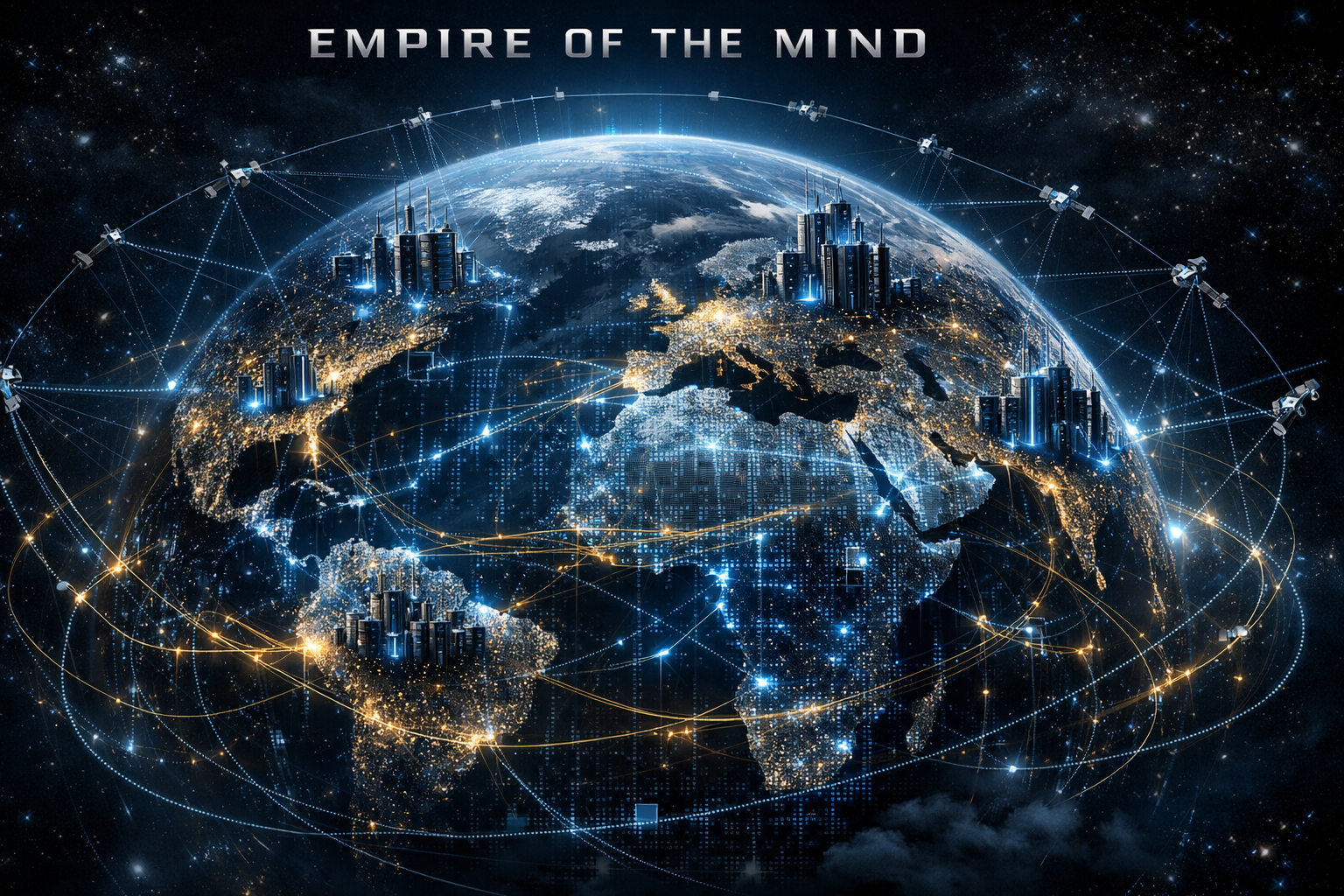
The foundational structure of global power is currently undergoing a phase transition as dramatic as the 19th-century shift from agrarian to industrial societies. 1 This transformation is characterized by a move away from territorial and military supremacy toward a paradigm defined by information processing asymmetry, entropy reduction capacity, and control over the physical and digital architectures of reasoning 2. In this 21st-century landscape, dominance is no longer a simple function of geographic size or kinetic force, but rather the ability of a state or corporate actor to maintain a predictive modeling advantage over its competitors 3. This shift manifests in the concentration of Artificial Intelligence (AI) compute, the control of submarine data arteries, the monopolization of advanced semiconductor fabrication, and the engineering of algorithmic narrative environments 4. Collectively, these factors constitute a new form of geopolitical leverage: Cognitive Sovereignty 5. 21st-century geopolitical dominance is increasingly determined by control over this cognitive infrastructure — data, compute, digital networks, and narrative platforms — rather than physical territory alone 1. Consequently, state sovereignty in the modern age must now include epistemic independence, or the ability of a society to interpret its own reality without structural reliance on foreign informational filters 1.
I. Historical Architecture of Power
Geopolitical dominance has historically evolved through a series of structural epochs, each defined by a primary strategic asset and the infrastructure required to harness it 6. The agrarian era was characterized by the control of arable land and caloric output, while the industrial era centered on mechanical production and the transportation of high-tonnage goods via rail and sea 7. The energy era of the 20th century focused on the control of hydrocarbons and the secure movement of molecules, leading to the rise of financialized information systems that prioritized the transmission of bits 8.
The current transition into the era of AI and compute represents a qualitative phase change because it focuses on the processing and interpretation of data rather than its mere transmission 9. This transition is fundamentally thermodynamic: previous power models were built around the combustion of molecules (petroleum, coal), a process that surrenders most of its energy to entropy 10. For example, in 2023, molecules achieved only a 29% efficiency in delivering useful work, whereas electron-based systems reached 68% 10. As the world enters the “Age of Electricity,” power accrues to those who can master the “electron economy” to power massive AI infrastructures 10.
A direct parallel exists between 20th-century oil chokepoints and 21st-century semiconductor chokepoints. Just as control over the Strait of Hormuz allowed states to regulate the flow of the global economy’s “master resource,” control over top-tier Graphics Processing Units (GPUs) and the lithography machines required to build them now determines which nations can participate in the frontier of human intelligence 11. This shift is further modeled by the decline of net energy; as the Energy Return on Investment (EROI) for petroleum is projected to fall below unity by 2081 12 , the petroleum-centric power model will cease to be viable. In its place, the “Intelligence Economy” utilizes AI to optimize the production and transport of energy, making the ability to reduce “societal entropy”—the disorder inherent in complex systems—the ultimate measure of national power 13.
II. Data as Strategic Substrate
Data serves as the raw material for cognitive power, but its strategic value is realized only through the infrastructure that moves, stores, and refines it 1. This infrastructure is currently characterized by an unprecedented level of concentration 4.
Cloud Market Concentration and Data Center Geography
Data refinement occurs in massive “Hyperscale” data centers, where the cloud infrastructure market is dominated by a narrow oligopoly 14. In 2024, the market was led by three American firms: Amazon (37.7%), Microsoft (23.9%), and Google (9.0%), who collectively operate two-thirds of the global market 15. The United States alone hosts roughly 51% of the world’s data centers 16, a concentration that forces other nations to rely on U.S.-based clouds for their most critical functions. For many middle powers, this concentration results in “Digital Dependency,” as they lack the domestic capacity to store and process their own national data independently 4.
Submarine Cable Ownership: The Physical Backbone
The physical backbone of the global internet consists of submarine fiber-optic cables that carry over 99% of intercontinental data traffic 17. As of 2025, there are approximately 597 active or planned cable systems stretching 1.5 million kilometers 17. Ownership has shifted from traditional telecom consortia to American technology giants like Google, Meta, and Amazon, who now operate 48% of non-U.S. data center projects by investment value and own substantial portions of the undersea network 4. Strategic maritime chokepoints elevate systemic risk; the Red Sea corridor alone handles approximately 17% of global internet traffic 18 , making it a critical digital “Achilles’ heel” vulnerable to accidental or deliberate disruption.
AI Training Compute and Prediction Advantage
Data enhances predictive capacity, which translates directly into geopolitical leverage 3. Access to massive datasets and high-end GPU clusters allows for the superior modeling of economic, military, and social scenarios, reducing internal uncertainty for the state 2. In 2025, frontier AI models were trained on between 14 and 36 trillion tokens, marking a logarithmic increase from the 300 billion tokens required in 2020 19. This “Data Moat” creates a structural advantage for those who can afford the billions of dollars required for training 20. When a region consumes AI produced elsewhere, it consumes not only the tool but also the worldview and cultural memory embedded in that tool’s training data 1.
III. Compute as the New Arms Race
The control of AI compute—the physical hardware required for large-scale training and inference—has become the primary lever of 21st-century statecraft 11. Compute asymmetry now functions as strategic asymmetry.
Semiconductor Fabrication Concentration
At the core of the AI revolution is an advanced semiconductor supply chain that is almost entirely dependent on Taiwan Semiconductor Manufacturing Company (TSMC). As of Q3 2025, TSMC produced approximately 90% of the world’s most advanced chips 21. The company’s “advanced technologies” (7nm and below) accounted for 74% of its revenue, highlighting a global total dependency on these specific process nodes 22. TSMC’s strategic importance is formalized in its 2025 capital expenditure of $40-$42 billion, 70% of which is dedicated to the advanced process technologies and packaging essential for AI accelerators 22. This concentration creates a “Silicon Shield” for Taiwan but also represents a catastrophic single point of failure for the global digital economy 21.
GPU and AI Chip Distribution
The actualization of compute power occurs in GPU clusters. By May 2025, the United States hosted 74.5% of global AI supercomputer performance 23, while China held 15% 23. Traditional technology leaders like Germany, Japan, and France have been relegated to marginal roles, with the entire EU bloc holding only 4.8% 23. This concentration reflects the dominance of U.S.-based technology companies and their unprecedented investment in “gigafactories” of chips 24. High-performance AI chips, such as the NVIDIA H100, are now the “power currency” of the world, and Washington uses export controls to decide who gets to train frontier models and who is “stuck on the sidelines” 11.
Export Controls and Strategic Restrictions
AI geopolitics now reaches deep into the semiconductor supply chain. Beginning in 2022, the U.S. implemented sweeping export controls to starve rival nations of the high-end GPUs critical for cutting-edge AI 25. These restrictions have repeatedly forced chipmakers to ship “China-only” variants with reduced performance or pause shipments entirely, reshaping national AI strategies overnight 11. By mid-2025, the U.S. effectively closed the last major chokepoint for top-tier hardware, signaling an intent to maintain a hardware advantage at all costs 25. These controls effectively impose a “ceiling” on the research potential of adversaries and allies alike.
IV. Narrative Infrastructure & Algorithmic Power
Dominance in the 21st century extends to the “Cognitive Domain”—the processes of human reasoning, belief, and emotion 26. Control over perception architecture is geopolitical power 27.
Platform Ownership and Attention Share
Algorithmic revolutions have coincided with the unprecedented concentration of media ownership in the digital realm 28. Five major platforms—Google, Facebook, Amazon, Apple, and Microsoft—now control the vast majority of digital information distribution 28. Google processes over 8.5 billion searches daily 28, creating a potent risk of media capture and manipulation 28.
Algorithmic Amplification and Polarization
Algorithmic ranking systems, optimized for engagement, disproportionately surface emotionally intense and polarizing content 29. Independent research published in Science in 2025 provides causal evidence that algorithmic ranking decisions directly alter the level of political polarization among users 30. Increasing a user’s exposure to partisan animosity was found to decrease “warmth” toward opposing parties at a rate comparable to three years of natural societal change occurring in just one week 30. This allows dominant platforms to engineer either the social cohesion or the fragmentation of rivals 31.
Cognitive Warfare and Institutional Trust
Adversaries like Russia and China are at the forefront of Cognitive Warfare, targeting human belief systems and social trust 26. Russia remains the leading source of “Coordinated Inauthentic Behavior” (CIB) disrupted by major platforms, having consolidated its operations around undermining international support for Ukraine 32. The goal of such operations is not military destruction, but the erosion of institutional legitimacy and the paralysis of decision-making 33. This transformation of culture from “soft power” to “hard defense” necessitates “Cognitive Resilience,” or the capacity of a society to maintain autonomy in its interpretation of reality 27.
V. Cognitive Sovereignty
Nations are responding to these concentrations of power by seeking to assert “Digital Sovereignty” and decouple from foreign infrastructure 34.
Comparative National Strategies
The global landscape is divided into distinct geopolitical models of governance 35:
- United States: Follows a “business-first” model, prioritizing the commercialization of data while increasingly utilizing “Chokepoint Statecraft” and export controls to protect national security interests 34.
- European Union: Prioritizes personal privacy and individual rights through the GDPR and the AI Act, though it is often criticized for acting primarily as a regulatory power rather than a technological one 34.
- China: Emphasizes state sovereignty and security, integrating data governance into social management and national security 36. China’s PIPL enforces strict data localization and security audits 34.
- India: Utilizes a hybrid “Digital Public Infrastructure” (DPI) model, combining state control with individual rights protection and an aggressive push to build domestic compute capacity (34k+ GPUs) to reduce reliance on foreign clouds 37.
Infrastructure Independence vs. Dependence
A new geopolitical stratification has emerged where only the U.S. and China enjoy “full-stack supply chain control” 37. Middle powers are structurally dependent on foreign models and foreign computing power 37. Regions like Latin America face a “semantic dependency cycle,” where models trained in the Global North mediate their reality 1. To counter this, initiatives like “LATAM GPT” represent political declarations of the right to interpret one’s own reality, signaling a shift from “Compute Colonialism” to “Cognitive Pluralism” 1.
VI. Strategic Futures
The future of the global order will be shaped by how nations navigate these infrastructural realities 16.
Scenario 1: The Digital Iron Curtain (Bipolar Fragmentation)
The world slides further into fragmentation, with a “Digital Iron Curtain” separating U.S.-led and China-led tech spheres 16. In this scenario, data centers, networks, and AI ecosystems are divided by incompatible standards and mutual suspicions, forcing all other nations to choose a side 16.
Scenario 2: Multipolar Realignment (The Rise of Middle Powers)
Middle powers weather superpower dominance by forming coalitions, such as the “Airbus for AI” initiative 37. Energy-rich states like the UAE and Saudi Arabia convert oil income into digital strength, building massive “Compute Hubs” to challenge the existing bipolarity 37.
Scenario 3: Corporate Supra-Sovereignty
Hyperscale technology companies become more powerful than most nation-states, moving to directly capture nuclear assets and renewable fleets to power their infrastructure 38. This privatization of critical energy infrastructure effectively blurs the lines between corporate mandates and national security strategy, allowing firms to act as sovereign agents in the global order 9.
Scenario 4: Cognitive Empires
“Cognitive Empires” emerge, built not on land but on the control of the foundational technological layers of politics and society 1. These empires use their compute-based dominance to enforce “Semantic Dependency” on their periphery, making sovereignty measured by the ability to produce meaning rather than the ability to defend territory 1.
Conclusion
Geopolitical power has fundamentally transitioned into a “Meaning-First” era 1. Sovereignty is now partially, and increasingly, defined by control over the cognitive infrastructure of data and compute 5. The United States is currently structurally advantaged, hosting 74.5% of global AI supercomputer performance and a dominant share of the world’s data centers23. Middle powers and the Global South remain structurally vulnerable, facing a “semantic dependency cycle” that risks turning them into epistemic subsidiaries of the Global North 1.
Cognitive Empires are indeed emerging; they are built on information-processing asymmetry and the control of the “electron economy” required to forge the world’s intelligence 10. In the 21st century, the hegemon is not the nation with the most territory, but the one with the highest Entropy Reduction Capacity—the ability to turn raw data into actionable intelligence more efficiently than its rivals 13. Sovereignty is no longer just about who rules the land, but who defines the cognitive architecture through which a society understands itself 1.
FAQ
What is meant by “Empire of the Mind”?
“Empire of the Mind” describes a form of geopolitical dominance rooted not in territorial expansion, but in control over data, AI compute, digital infrastructure, and narrative systems. It refers to the ability to shape how reality is interpreted, predicted, and acted upon through cognitive infrastructure.
What is cognitive sovereignty?
Cognitive sovereignty is a nation’s ability to independently control its data flows, AI systems, semiconductor access, cloud infrastructure, and digital communication platforms. It represents epistemic independence — the ability to structure one’s informational environment without structural dependency on foreign infrastructure.
How is data becoming a geopolitical asset?
Data enhances predictive capability. Unlike oil or minerals, data is recursive: more data improves AI systems, and improved AI systems generate more data. This compounding advantage creates structural asymmetry between states and corporations with large-scale data access and those without it.
Is data really “the new oil”?
The oil metaphor is incomplete. Oil is consumed; data is reused. Oil is finite; data compounds. Oil fuels industry; data fuels prediction. The more accurate a nation’s predictive models, the greater its economic, military, and strategic leverage.
Why is AI compute considered a new arms race?
Advanced AI systems require enormous computational resources and high-end semiconductors. The concentration of GPU clusters, advanced chip fabrication (such as cutting-edge semiconductor foundries), and AI research capacity creates chokepoints similar to historical naval or energy chokepoints. Compute asymmetry translates into strategic asymmetry.
Why are semiconductors central to global power?
Semiconductors power AI systems, defense technologies, satellites, communication networks, and financial infrastructure. Advanced fabrication is geographically concentrated, making it a strategic vulnerability and a lever of geopolitical influence.
What is algorithmic power?
Algorithmic power refers to the ability of ranking, recommendation, and search systems to determine visibility and relevance in digital environments. Since most public discourse is mediated by platforms, algorithmic filtering indirectly shapes public opinion, political outcomes, and cultural norms.
How do algorithms influence geopolitics?
Algorithms shape attention allocation. Attention shapes belief formation. Belief formation shapes political behavior. Therefore, control over digital platforms can influence electoral dynamics, polarization, institutional trust, and geopolitical alignment.
What is narrative sovereignty?
Narrative sovereignty is the capacity to define and circulate dominant interpretive frameworks without dependence on external digital infrastructure. It involves control over media ecosystems, AI-generated content systems, and global communication networks.
How is this different from traditional “soft power”?
Soft power refers to cultural attraction and diplomatic influence. Cognitive sovereignty goes deeper: it concerns structural control over the infrastructure that determines how narratives are distributed, amplified, and interpreted.
What is data colonialism?
Data colonialism describes a dynamic in which powerful states or corporations extract data from other regions while retaining control over processing infrastructure and AI systems. This can create long-term economic and epistemic dependency.
How does cloud infrastructure affect sovereignty?
Cloud infrastructure hosts government databases, economic systems, AI workloads, and defense coordination tools. Heavy reliance on foreign cloud providers can introduce strategic vulnerabilities and limit autonomy.
Are corporations becoming geopolitical actors?
In some domains, multinational technology firms control cloud systems, AI models, communication platforms, and digital infrastructure at scales rivaling nation-states. This creates hybrid sovereignty dynamics where corporate power intersects with national security concerns.
What policies aim to secure digital sovereignty?
Common strategies include:
- AI export controls
- Semiconductor investment programs
- Data localization laws
- National cloud infrastructure
- Domestic AI model development
- Undersea cable independence initiatives
These policies aim to reduce infrastructure dependency.
Is physical military power becoming irrelevant?
No. Military power remains central. However, modern military systems rely heavily on AI, satellite networks, predictive analytics, and digital infrastructure. Physical power increasingly depends on cognitive infrastructure.
What are cognitive empires?
Cognitive empires are political or corporate entities that dominate the infrastructures through which information flows, perception is shaped, and predictive systems operate. Sovereignty in such systems is measured not only in territory but in teraflops, data volumes, and algorithmic reach.
What are the risks of concentrated cognitive power?
Potential risks include:
- Infrastructure dependency
- Narrative manipulation
- Democratic erosion
- Algorithmic centralization
- Digital fragmentation into geopolitical blocs
Which countries currently dominate AI infrastructure?
The United States and China lead in AI compute capacity, semiconductor design, large-scale model development, and digital platform reach. The European Union and India are pursuing strategic autonomy initiatives to reduce dependence.
What are possible future scenarios?
- Continued dominance by a single AI superpower
- Emergence of competing digital blocs
- Multipolar fragmentation of global data ecosystems
- Corporate supra-sovereignty where firms rival states
Each scenario depends on infrastructure concentration and policy choices.
How does this affect individuals?
Individuals increasingly experience economic opportunity, social interaction, and political discourse through digital systems. If infrastructure is concentrated, personal agency may be indirectly shaped by algorithmic systems beyond democratic oversight.
What is the central takeaway?
The defining feature of 21st-century power may be control over cognitive infrastructure: data, compute, semiconductor supply chains, cloud systems, and narrative platforms. Sovereignty now extends beyond borders into the architectures that structure perception, prediction, and decision-making.