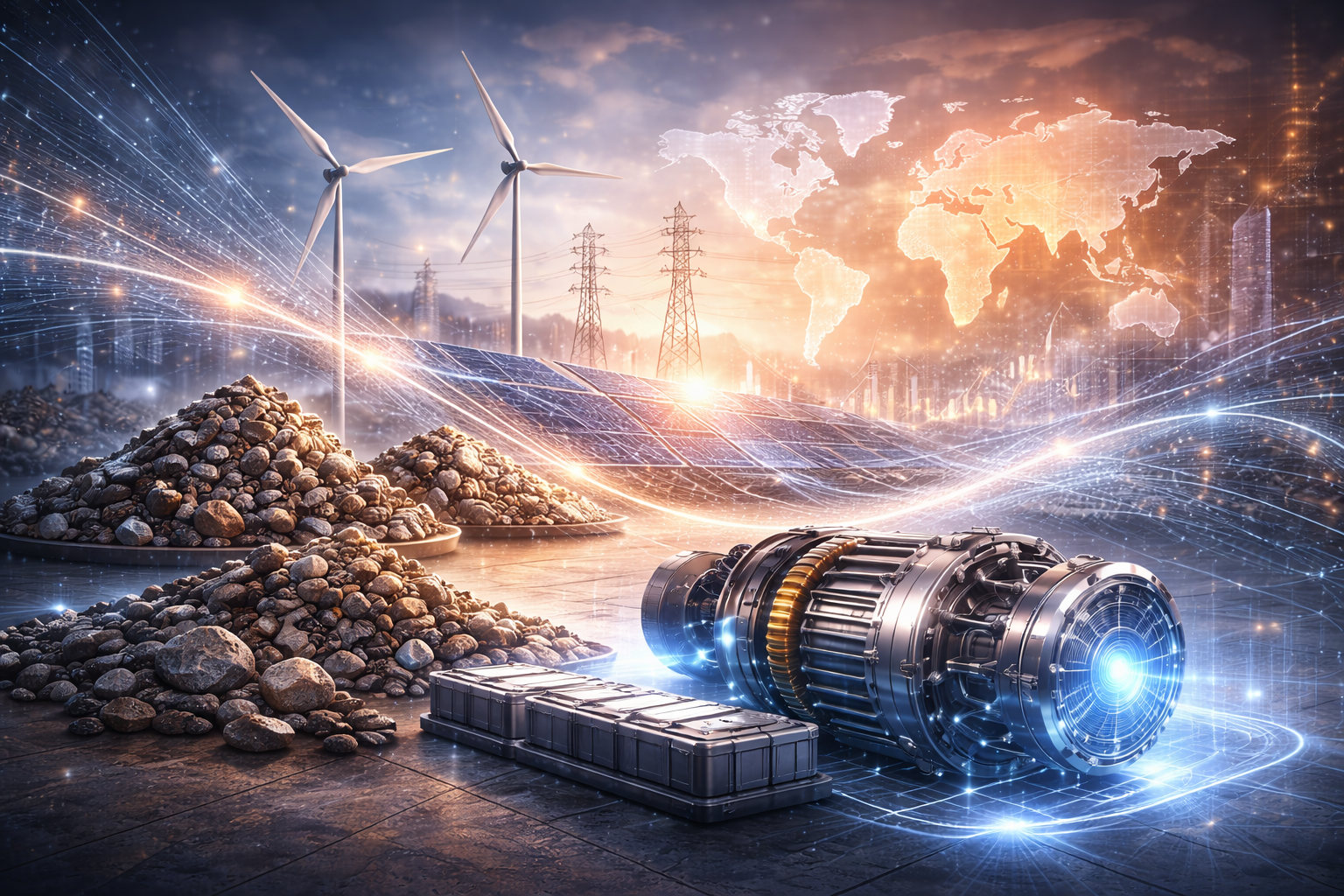
What Are Critical Minerals?
Critical minerals are raw materials that are essential to modern energy systems but face elevated supply risk due to geological scarcity, slow production timelines, environmental constraints, or geopolitical concentration.
In the context of the energy transition, critical minerals typically include:
- Copper
- Lithium
- Nickel
- Cobalt
- Graphite
- Rare earth elements
These materials form the physical backbone of electric vehicles, renewable power generation, grid infrastructure, batteries, and the digital systems required to operate a low-carbon economy.
From Fuel-Intensive to Mineral-Intensive Energy Systems
The push toward Net-Zero Emissions by 2050 represents a fundamental restructuring of the global industrial system.
Fossil-fuel energy systems are fuel-intensive but material-light once infrastructure is built. Clean energy systems, by contrast, are mineral-intensive upfront, requiring large quantities of metals before a single unit of energy is produced.
Electric vehicles, wind turbines, solar photovoltaics, expanded power grids, and data-driven infrastructure require multiples more minerals than their fossil-fuel predecessors. This creates a front-loaded demand shock that global mining systems were never designed to absorb quickly.
The Copper Crunch: The Metal of Electrification
Copper sits at the center of the energy transition.
Every electrified system — electric vehicles, charging networks, renewables, transmission lines, and data centers — depends on copper’s electrical conductivity.
Global refined copper demand is projected to nearly double, rising from approximately 25 million metric tons today to nearly 49 million metric tons by 2035.
Why demand is accelerating
-
Electric Vehicles:
Battery-electric vehicles require roughly 2.5× more copper than internal combustion engine vehicles. -
AI and Digital Infrastructure:
Data centers, cloud computing, and AI workloads are driving electricity demand well beyond historical planning assumptions. -
Grid Expansion:
Global power grid investment must more than double by 2040 to support widespread electrification.
Under conservative supply expansion assumptions, the world faces a 9.9 million metric ton copper shortfall by 2035, equivalent to roughly 20% of Net-Zero-aligned demand.
The $700 Billion Mining Investment Gap
Meeting climate and clean-energy targets requires an unprecedented surge in mining and processing investment.
Demand for clean-energy minerals is projected to grow by more than 400% by 2030, yet current supply pipelines remain insufficient:
- Natural Graphite: 46% projected deficit
- Cobalt: 42% projected deficit
- Lithium: 34% projected deficit
- Copper: 15% projected deficit
Bridging these gaps requires over $700 billion in cumulative mining investment through 2050, with nearly three-quarters of that capital required by 2030.
Mining investment delays today translate directly into physical shortages a decade later. Capital timing — not just capital volume — is the binding constraint.
Why Mining Cannot Scale on Demand
Mining does not respond quickly to price signals.
Structural bottlenecks include:
-
Long Lead Times:
It takes more than 16 years on average to move from discovery to first production. -
Declining Ore Grades:
Major producers such as Chile and Peru must process increasing volumes of material to extract the same amount of copper, driving costs and emissions higher. -
Permitting and Litigation:
In the United States and parts of Europe, complex permitting regimes and legal challenges make large-scale domestic expansion unlikely within the next decade.
By 2035, the United States is projected to import 57–67% of its copper demand, deepening strategic dependence even as electrification accelerates.
Geopolitics and the Concentration Risk
Critical mineral supply chains are more concentrated than oil ever was in the twentieth century.
- China controls approximately 90% of global rare-earth processing
- More than 40% of global copper refining capacity
This concentration has already translated into real-world disruption.
The 2025 Rare Earth Shock
In April 2025, export restrictions on rare earth elements triggered immediate global consequences:
- Temporary factory shutdowns in Europe and North America
- A Ford manufacturing plant closure
- Bajaj Auto’s electric scooter production in India fell nearly 50% in a single month
The episode exposed how vulnerable clean-energy supply chains remain to geopolitical leverage.
Strategic Resilience: The Multilateral Commercial Stockpile
To mitigate supply coercion and market volatility, policy experts have proposed a Multilateral Commercial Stockpile (MCS).
How the MCS would function
- Maintain 12 months of peacetime demand for high-risk minerals such as magnesium, tungsten, and antimony
- Act as a buyer of last resort when prices are artificially depressed
- Act as a seller of last resort during supply shocks
An initial $500 million in public funding could seed the stockpile, with long-term sustainability achieved through commercial participation.
Recycling, Urban Mining, and Cleaner Processing
With primary mining constrained, recycling is no longer optional.
Urban mining potential
Printed circuit boards contain:
- 80–1000 g/t of gold
- Compared to less than 40 g/t in high-grade natural ore
Green hydrometallurgy
Traditional cyanide-based recovery methods are increasingly challenged by thiosulfate-based leaching, which has demonstrated:
- Comparable metal recovery efficiency
- Approximately 83% higher sustainability than cyanide systems
Recycling alone cannot close near-term supply gaps, but it is essential for long-term resilience.
What Happens If Supply Falls Short?
If mineral supply fails to scale in time, the consequences are systemic:
- Higher clean-energy costs
- Slower electric vehicle and renewable deployment
- Increased geopolitical tension
- Fragmented energy transitions across regions
This would represent a 21st-century replay of 20th-century oil shocks, with minerals replacing hydrocarbons as the primary constraint.
Conclusion: A Generational Industrial Challenge
The energy transition is not merely a technological shift. It is a monumental mining, capital allocation, and geopolitical challenge.
Without:
- Accelerated capital deployment
- Faster permitting timelines
- Strategic stockpiles
- Scaled recycling innovation
…the world risks short-circuiting its own climate ambitions.
The constraints are physical.
The timelines are unforgiving.
The remaining question is whether policy, capital, and industry can respond fast enough.
FAQ
What are critical minerals in the energy transition?
Critical minerals are raw materials that are essential for clean energy technologies but face high supply risk due to geological scarcity, long mining timelines, environmental constraints, or geopolitical concentration. In the energy transition, these minerals include copper, lithium, nickel, cobalt, graphite, and rare earth elements, all of which are required for electric vehicles, renewable power generation, energy storage, and grid infrastructure.
Why are critical minerals so important for achieving net zero?
The shift to net-zero emissions requires electrification of transport, power generation, and industry. Clean energy systems are significantly more mineral-intensive than fossil-fuel systems. For example, electric vehicles require multiple times more copper than conventional cars, and renewable energy infrastructure requires large upfront quantities of metals. Without sufficient mineral supply, clean energy deployment slows and costs rise.
Which critical mineral is the biggest bottleneck in the energy transition?
Copper is widely considered the most immediate bottleneck because it is required across almost every electrified system, from vehicles and power grids to data centers. Global copper demand is projected to nearly double by 2035, while supply expansion is constrained by long project lead times, declining ore grades, and limited new discoveries.
Is there a shortage of critical minerals globally?
While absolute scarcity is not the issue, the world faces a structural supply shortage driven by slow mining expansion, underinvestment, and rapid demand growth. Under current trajectories, significant deficits are projected for minerals such as lithium, cobalt, graphite, and copper, particularly during the 2030–2040 period.
Why can’t mining scale fast enough to meet demand?
Mining projects typically take more than 16 years to move from discovery to production. Regulatory approvals, community opposition, declining ore quality, and high capital requirements slow expansion. Unlike manufacturing, mining cannot respond quickly to price signals, making short-term supply growth extremely limited.
How does geopolitics affect critical mineral supply chains?
Critical mineral supply chains are highly concentrated geographically. China controls the majority of rare-earth processing and a large share of global refining capacity for other minerals. This concentration creates geopolitical risk, as export restrictions or trade conflicts can quickly disrupt global manufacturing and clean energy deployment.
What was the 2025 rare earth shock?
In April 2025, restrictions on rare earth exports led to immediate disruptions in manufacturing across Europe, North America, and India. Electric vehicle and electronics production slowed, and some factories were temporarily shut down. The episode highlighted the fragility of clean-energy supply chains and the strategic leverage embedded in critical mineral control.
Can recycling solve the critical minerals shortage?
Recycling and urban mining are essential parts of the solution but cannot fully address near-term shortages. Recycling depends on past consumption, which limits how quickly supply can scale. However, over the long term, improved recycling technologies can significantly reduce dependence on primary mining and lower environmental risk.
What is urban mining?
Urban mining refers to the recovery of valuable metals from electronic waste, such as discarded circuit boards and batteries. These materials often contain higher metal concentrations than natural ores, making them an important secondary source of critical minerals when paired with efficient processing technologies.
What are strategic or commercial stockpiles?
Strategic or commercial stockpiles are reserves of critical minerals maintained to protect against supply disruptions and price volatility. Proposals such as a Multilateral Commercial Stockpile aim to stabilize markets by acting as a buyer of last resort during oversupply and a seller of last resort during shortages.
How does the critical minerals issue affect India specifically?
India is highly exposed to critical mineral supply risks due to limited domestic resources and growing demand for electric vehicles, renewable energy, and electronics manufacturing. Disruptions in rare earth or battery material supply can directly impact domestic production, as seen during the 2025 rare earth shock, when electric two-wheeler output fell sharply.
What happens if critical mineral supply does not keep pace with demand?
If supply growth lags demand, clean energy technologies become more expensive and harder to deploy at scale. This can slow progress toward net-zero targets, increase geopolitical tensions, and lead to uneven energy transitions across regions, similar to oil shocks in the twentieth century.
Are critical mineral shortages a temporary problem?
No. The challenge is structural rather than cyclical. Even with higher prices, mining expansion takes decades. Without early and sustained investment, permitting reform, and recycling innovation, supply constraints are likely to persist well into the 2030s and beyond.