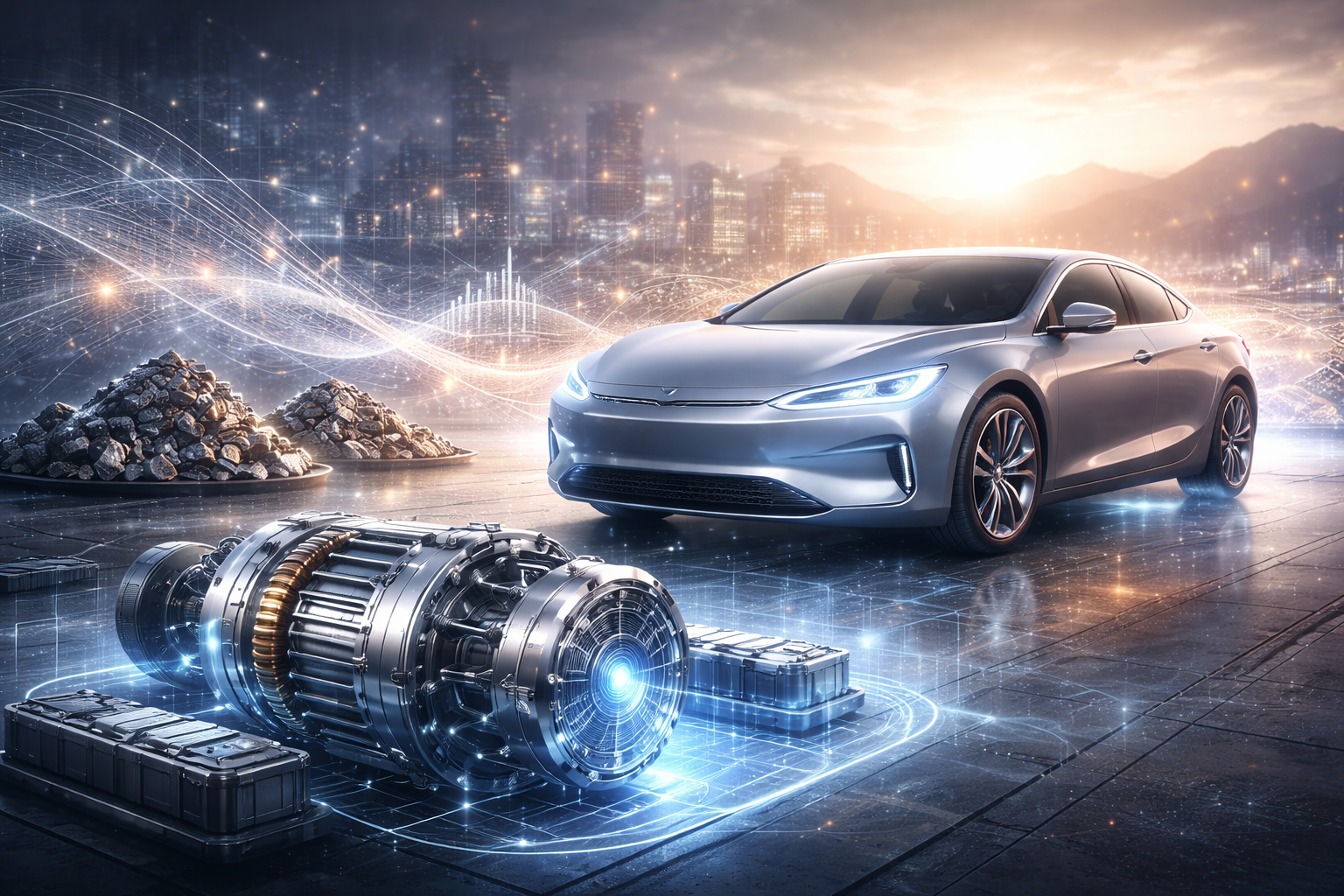
Rare Earth Free EV Motors and the Global Decoupling of Electric Mobility
The global automotive industry is undergoing its most profound technological transition since the invention of the internal combustion engine. At the core of this shift lies what many engineers now describe as the new Auto Holy Grail: building high-performance electric motors without dependence on Chinese rare-earth elements.
For decades, permanent magnet synchronous motors (PMSMs) dominated EV design, leveraging neodymium, dysprosium, and terbium to achieve compact, high-efficiency performance. That design assumption is now being dismantled—not by environmental pressure alone, but by geopolitical risk, economic volatility, and systemic supply fragility.
What is unfolding is not merely an engineering evolution, but a structural decoupling of global industrial dependency.
What Are Rare Earth Free EV Motors?
Rare earth free EV motors are electric vehicle motors that operate without permanent magnets made from rare earth elements such as neodymium, dysprosium, or terbium. Instead, they generate magnetic fields using electrical excitation, inductive systems, or non-rare-earth magnetic materials, reducing exposure to geopolitically concentrated supply chains.
This shift is redefining how performance, cost, and resilience are evaluated in electric mobility.
Why Rare Earth Dependence Became a Strategic Risk
China currently controls close to 90% of global rare-earth processing capacity and between 85–90% of refining operations. This dominance has transformed rare earth materials into a geopolitical lever—one that has already been deployed through export restrictions and trade retaliation.
The economic consequences are material:
- Cost asymmetry: Rare-earth magnets cost approximately ₹6,000/kg, compared to ₹400/kg for ferrite alternatives.
- Market transmission: In early 2025, rare-earth shortages translated directly into EV price hikes of up to 8% in India.
- Scaling pressure: A single EV requires 1–2 kg of rare-earth magnets. With India projected to add 14 million EVs by 2030, import dependence becomes structurally unsustainable.
Rare earth reliance is no longer a sourcing issue—it is a strategic exposure embedded deep within the EV value chain.
How Automakers Are Building EV Motors Without Rare Earth Magnets
To escape this dependency, manufacturers are pursuing three rare-earth-free motor architectures, each optimized for different performance, cost, and scaling constraints.
Electrically Excited Synchronous Motors (BMW)
BMW has emerged as a frontrunner with its fifth-generation eDrive motors, deployed across the i4, iX, and i7 platforms.
Instead of permanent magnets, these motors generate magnetic fields using electrical excitation.
Key breakthroughs include:
- Performance parity: The BMW iX M60 produces 610 horsepower and accelerates from 0–60 mph in 3.6 seconds.
- Durability engineering: Advanced sealing technology encapsulates brushes, mitigating dust contamination and extending service life—historically the Achilles’ heel of brushed systems.
This architecture directly challenges the assumption that rare-earth-free motors must sacrifice performance.
Inductively Excited Motors (MAHLE and ZF)
MAHLE and ZF are advancing inductively excited synchronous motors, eliminating both permanent magnets and physical brushes.
- Efficiency: MAHLE reports 95% efficiency, previously achievable only in Formula E–grade systems.
- Compact design: ZF’s I2SM architecture integrates the exciter inside the rotor shaft, reducing axial length by 90 mm.
- Carbon footprint: ZF estimates up to a 50% reduction in CO₂ emissions during motor production.
These designs demonstrate that resilience and efficiency are no longer mutually exclusive in modern EV motor engineering.
Ferrite-Based EV Motors for Mass-Market Scale
For cost-sensitive and high-volume EV segments, ferrite magnets are re-emerging as a viable alternative.
- Indian innovation: Ola Electric has deployed ferrite-based motors in two-wheelers, while startup Conifer claims 10–30% range improvements through design optimisation.
- Manufacturing economics: Ferrite motors can be 30–60% cheaper to manufacture than rare-earth PMSMs.
Ferrite is not a compromise—it is a scaling strategy for mass electrification.
India’s Rare Earth Exposure and Strategic Pivot
India remains acutely exposed, importing 65% of its rare-earth requirements from China, despite holding the world’s fifth-largest reserves. The bottleneck is not geology—it is processing capacity.
India’s counter-strategy now includes:
-
National Critical Mineral Mission (2025)
₹34,000 crore allocated toward processing infrastructure and mineral parks. -
Domestic Magnet Manufacturing Scheme
₹7,300 crore earmarked to produce 6,000 tonnes of rare-earth magnets annually within seven years. -
Global Mineral Partnerships
Through KABIL, India has secured lithium assets in Argentina and is negotiating supply lines with Chile, Brazil, and Namibia.
This represents a shift from commodity importation to a sovereign materials strategy.
Beyond Rare Earths: The Scientific Frontier
Long-term disruption may come from materials that were never part of terrestrial supply chains.
- Tetrataenite synthesis: Researchers are accelerating the formation of this meteorite-derived magnetic material from geological timescales to weeks.
- AI-driven materials discovery: The U.S. Department of Energy is deploying AI systems to discover magnets potentially twice as powerful as current rare-earth alternatives.
Here, software is compressing materials science timelines by orders of magnitude.
Conclusion: Resilience Is the New Performance Metric
The race toward rare earth free EV motors is no longer about sustainability or marginal efficiency gains. It is about strategic resilience.
While rare-earth PMSMs may retain dominance in ultra-premium performance segments, the center of gravity is shifting. Electrically excited, inductively excited, and ferrite-based designs ensure that mass-market electrification cannot be throttled by a single geopolitical chokepoint.
The Auto Holy Grail has changed.
It is no longer the most powerful motor—it is the most sovereign, scalable, and resilient one.
FAQ
Do EVs need rare earth magnets?
No. Electric vehicles do not inherently require rare earth magnets. Many EV motors operate without them by using electrical excitation, inductive systems, or ferrite-based magnetic materials, which significantly reduce dependence on rare earth supply chains.
What are rare earth free EV motors?
Rare earth free EV motors are electric vehicle motors designed without permanent magnets made from rare earth elements such as neodymium or dysprosium. Instead, they rely on electrically excited rotors, inductive excitation, or non–rare-earth magnetic materials.
Are rare earth free EV motors less efficient than permanent magnet motors?
Not necessarily. Modern rare earth free motor designs can achieve efficiency levels comparable to permanent magnet synchronous motors, while offering greater supply-chain resilience and lower geopolitical risk.
Why is China dominant in rare earth processing?
China built extensive rare earth processing and refining infrastructure decades earlier than most countries, giving it control over a majority of global refining capacity—even though it does not hold a majority of global reserves.
Which automakers are using rare earth free EV motors?
Automakers such as BMW, along with suppliers like MAHLE and ZF, are already deploying or developing EV motor architectures that avoid rare earth magnets through electrical or inductive excitation.
Are ferrite motors suitable for mass-market EVs?
Yes. Ferrite-based motors are well-suited for cost-sensitive and high-volume EV segments. While ferrite magnets are less powerful than rare earth magnets, optimized motor design can offset this limitation at significantly lower cost.
Why are rare earth free EV motors important for India?
India imports a large share of its rare earth requirements despite holding substantial reserves. Rare earth free EV motors reduce exposure to import risks, price volatility, and geopolitical pressure, making large-scale electrification more sustainable.
Will rare earth magnets disappear from EVs completely?
Unlikely in the near term. Rare earth magnets may continue to be used in ultra-premium or high-performance EV segments, while rare earth free motor designs are expected to dominate mass-market and strategically critical applications.