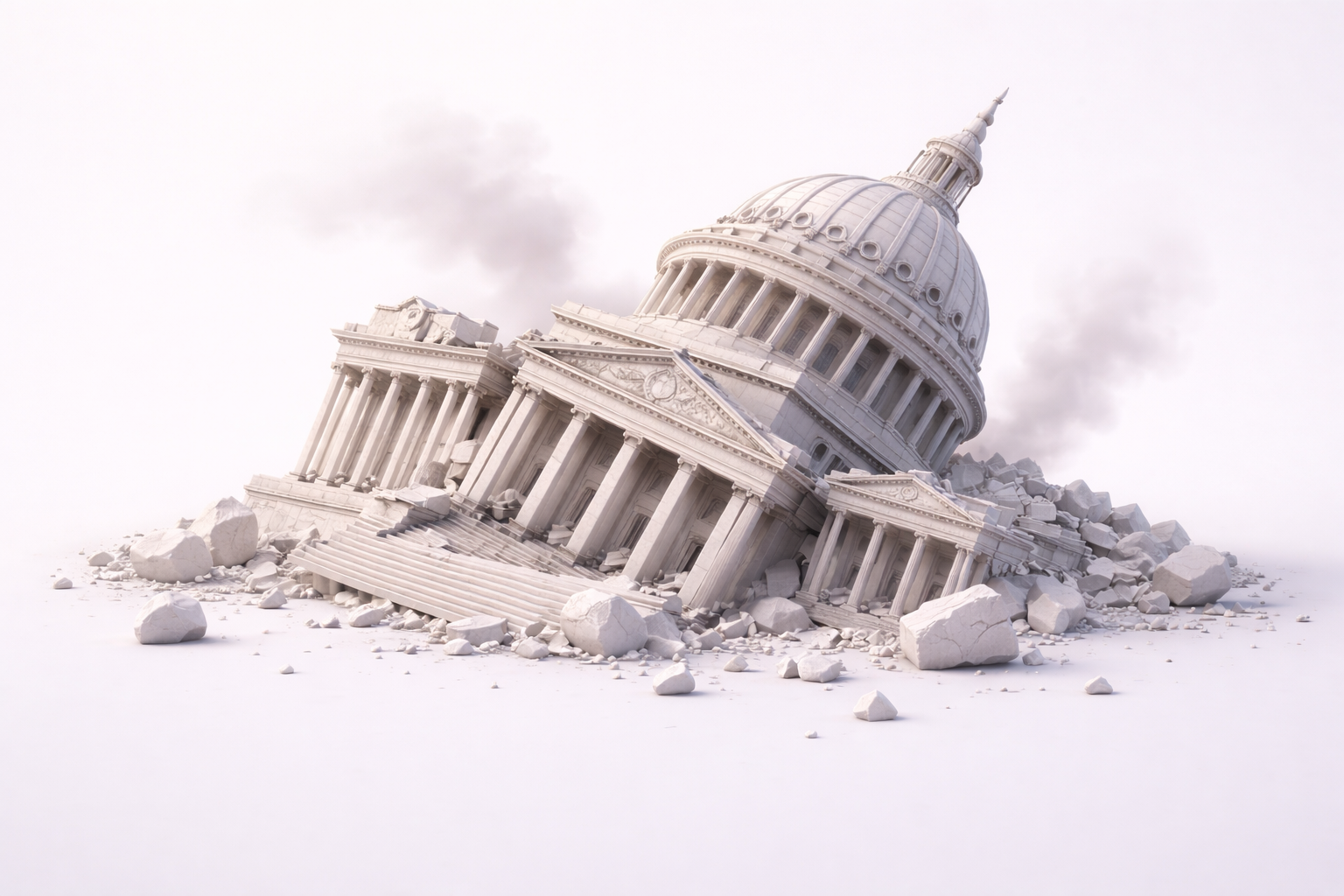
Why Governments Decline: The Endogenous Decay of High-Functioning Power
Decline as an Internal Process
The dominant intuition about political decline is catastrophist. Governments, it is commonly assumed, collapse because they are invaded, corrupted, defeated, or mismanaged. Decline is imagined as a failure event—a rupture imposed from the outside or triggered by spectacular incompetence at the top. This intuition is historically shallow and analytically misleading.
The deeper historical and philosophical record suggests a more unsettling conclusion: the better a government functions, and the longer it maintains stability, the more predictable its eventual decline becomes. This decline is not imposed upon the system; it is generated by the system. It is endogenous, not exogenous.
This article develops that argument in full, without simplification. It draws together political sociology, institutional economics, anthropology, philosophy, and comparative imperial history to show that decline is not an aberration of governance, but a structural consequence of success.
The core thesis is simple but corrosive: governments do not decay despite order, efficiency, and stability—they decay because of them.
This mechanism is explored systematically in
The Entropy of Excellence: A Research Report on the Endogenous Decay of High-Functioning Governance
I. The Entropy of Excellence: Why Order Generates Fragility
In physical systems, entropy describes the tendency of structured arrangements to degrade unless energy is continuously expended to maintain them. Political systems exhibit an inverse but analogous tendency. Rather than drifting toward disorder, successful governments drift toward over-structure—excessive hierarchy, regulation, specialization, and procedural density.
As governance improves, it solves problems by building institutions. Each solution adds layers: agencies, laws, compliance regimes, professional classes, and enforcement mechanisms. Initially, these additions raise capacity and legitimacy. Over time, they accumulate costs.
The paradox is that high-functioning governance produces structural brittleness. When systems become too optimized for existing conditions, they lose the capacity to adapt to new ones. Efficiency becomes rigidity. Stability becomes sclerosis.
This process does not require corruption or bad faith. It arises naturally from incentive alignment within stable systems. Actors who benefit from existing arrangements invest resources to preserve them. Institutions develop self-reinforcing logics. Reform becomes politically expensive, administratively complex, and socially destabilizing.
Decline begins not when institutions stop working, but when they begin working only for themselves.
II. Political Stability as a Dynamic, Not Static, Achievement
Political stability is often treated as an end state: once achieved, it can be maintained through vigilance and competence. History does not support this view. Stability is not static; it is a dynamic equilibrium that constantly alters the incentives of those operating within it.
Long periods of stability produce predictable secondary effects:
- Interests that were once diffuse become organized
- Administrative functions professionalize and entrench
- Leadership roles ossify into career tracks
- Risk-taking declines while proceduralism increases
- Legitimacy shifts from performance to precedent
These shifts are cumulative. None are fatal in isolation. Together, they transform adaptive systems into preservationist ones.
This dynamic explains why decline is often invisible until late stages. The system continues to function. Laws are enforced. Services are delivered. Yet beneath this surface order, flexibility erodes.
III. Ibn Khaldun and the Biological Model of Political Power
No thinker articulated this dynamic earlier or more precisely than Ibn Khaldun.
As explored in
Ibn Khaldun’s Cyclical Theory on the Rise and Fall of Sovereign Powers
and
Genealogy, Critique, and Decolonisation: Ibn Khaldun
Ibn Khaldun conceptualized political entities not as legal constructs but as living organisms governed by internal lifecycles.
Asabiyyah as the Source of Power
At the core of Ibn Khaldun’s theory is asabiyyah—group solidarity forged through hardship. Political power originates among groups exposed to scarcity, danger, and collective struggle. Under such conditions, trust, discipline, and competence are existential necessities.
These groups conquer sedentary societies not because they are morally superior, but because their social cohesion is stronger.
The State as the Beginning of Decline
Crucially, Ibn Khaldun argued that the founding of a state marks the beginning of decay. Settlement replaces mobility. Comfort replaces discipline. Institutions replace personal obligation. The very success of conquest initiates decline.
The Four-Generation Cycle
Ibn Khaldun estimated the lifespan of political dynasties at roughly 120 years, unfolding across four generations:
-
The Founding Generation
Defined by toughness, shared sacrifice, and restrained leadership. Power is functional, not ornamental. -
The Consolidating Generation
Authority centralizes. Professional armies and administrative systems emerge. Luxury appears but remains secondary. -
The Leisure Generation
Prosperity peaks. The original virtues are remembered but no longer practiced. Risk aversion replaces courage. -
The Decadent Generation
Consumption dominates production. Social cohesion dissolves. Elites blame predecessors while hollowing institutions.
This cycle is not moralistic. It is structural.
IV. The Ottoman Empire: Delayed but Not Escaped
The Ottoman Empire, often cited as an exception, serves instead as a confirmation of Ibn Khaldun’s model.
As detailed in
Ibn Khaldun’s Cyclical Theory on the Ottoman Empire
the Ottomans extended their lifespan by institutionalizing renewal mechanisms—meritocratic recruitment, military discipline, and administrative rationality.
Phases of Ottoman Power
-
Foundation (1299–1453)
Tribal solidarity, martial competence, and fluid leadership structures. -
Expansion (1512–1579)
Wealth redistribution, administrative sophistication, centralized authority. -
Stagnation (1579–1730)
Bureaucratic closure, elite insulation, declining adaptability. -
Decline (1730–1922)
Fiscal exhaustion, talent flight, institutional rigidity, legitimacy erosion.
By its final centuries, the empire functioned administratively while failing strategically—a textbook case of endogenous decay.
V. Organization and Its Betrayal: Robert Michels’ Iron Law
If Ibn Khaldun explains dynastic decline, Robert Michels explains organizational decay.
In Oligarchy, Iron Law of,
Oligarchy, Iron Law of
Michels demonstrated that organization itself produces oligarchy.
The Structural Necessity of Bureaucracy
Large-scale coordination requires hierarchy. Hierarchy requires specialization. Specialization produces information asymmetry. Information asymmetry concentrates power.
The Three-Step Trap
- Bureaucracy becomes unavoidable
- Expertise becomes monopolized
- Leadership becomes self-protective
The result is goal displacement: organizations exist to preserve themselves rather than serve their founding purpose.
Democracy does not escape this logic. It merely delays it.
VI. Institutional Accumulation and Economic Paralysis: Mancur Olson’s Theory of Distributional Coalitions
If Ibn Khaldun explains decline through the erosion of social cohesion and Michels through the inevitability of oligarchic organization, Mancur Olson provides the economic mechanism by which long-stable societies lose dynamism. Olson’s contribution is critical because it explains why decline persists even when political order, security, and formal governance remain intact.
Olson’s theory is most fully articulated in The Rise and Decline of Nations, summarized and extended in:
Institutional Sclerosis
The Rise and Decline of Nations – Summary
Stability as the Precondition for Rent-Seeking
Olson’s central claim is counterintuitive: political stability, not instability, is the primary condition for long-term economic stagnation. In unstable societies, interest groups struggle to persist. In stable ones, they flourish.
As stability persists, societies accumulate what Olson calls distributional coalitions—small, organized groups capable of coordinating their actions to extract benefits for themselves while imposing diffuse costs on the broader population. These coalitions do not produce wealth; they redistribute it toward their members.
Examples include:
- Professional licensing bodies that restrict entry
- Trade unions that protect insiders at the expense of outsiders
- Industry lobbies that secure tariffs, subsidies, or regulatory protection
- Bureaucratic agencies that expand mandates regardless of outcomes
Because the costs of these arrangements are spread thinly across millions, opposition rarely mobilizes effectively. The benefits, however, are concentrated and fiercely defended.
Institutional Sclerosis as an Emergent Property
Over long periods of stability, these coalitions accumulate, layer upon layer, embedding themselves into law, regulation, and administrative practice. The result is institutional sclerosis—a condition in which the economy remains formally functional but becomes increasingly immobile.
Innovation slows not because ideas disappear, but because:
- Entry barriers rise
- Regulatory complexity increases
- Legal risk escalates
- Established interests veto change
Olson emphasized that these coalitions are not aberrations or moral failures. They are rational responses to stable political environments.
Why Defeat Can Restore Dynamism
One of Olson’s most controversial observations was that total institutional destruction can restore growth. Post-war Germany and Japan experienced rapid economic recovery not despite defeat, but because defeat wiped out entrenched coalitions that had accumulated over decades.
By contrast, Great Britain—victorious, stable, and institutionally continuous—suffered prolonged stagnation due to the persistence of entrenched interests.
This insight reinforces the core thesis of endogenous decline: success preserves structures that eventually obstruct adaptation.
VII. Bureaucratic Expansion and the Cost of Administration
Olson’s theory intersects directly with empirical research on bureaucratic growth. Even in the absence of corruption, administrative bodies tend to expand over time, consuming increasing resources while delivering diminishing marginal returns.
This phenomenon is formalized in Parkinson’s Law, quantified empirically in:
Parkinson’s Law Quantified: Three Investigations on Bureaucratic Inefficiency
Parkinson demonstrated that:
- Administrative staff numbers grow independent of workload
- Decision-making efficiency declines as committees exceed optimal size
- Coordination costs increase nonlinearly
The result is a governance structure that remains active, busy, and procedurally dense—but increasingly ineffective at solving new problems.
VIII. Complexity and Diminishing Returns: Joseph Tainter’s Model of Collapse
Where Olson explains stagnation, Joseph Tainter explains collapse.
In The Collapse of Complex Societies, summarized in:
The Possible Relevance of Joseph Tainter
The Collapse of Complex Societies – Overview
Tainter conceptualizes societies as problem-solving organizations. When confronted with challenges—military threats, resource scarcity, administrative needs—societies respond by increasing complexity.
Complexity as Investment
Initially, complexity yields positive returns:
- Larger armies enable conquest
- Bureaucracies improve coordination
- Infrastructure supports growth
However, each increment of complexity imposes costs. Over time, returns diminish.
Eventually, societies reach a point where:
- Additional complexity yields zero returns
- Maintenance costs exceed benefits
- Taxation rises without proportional gains
At this stage, the system becomes vulnerable to shocks—not because it is weak, but because it is too costly to sustain.
Collapse as Rational Simplification
Tainter defines collapse not as chaos, but as rapid simplification—a rational reduction of complexity when its costs become unbearable.
Historical examples include:
- Roman peasants welcoming barbarian rule to escape taxation
- Administrative retreat in post-collapse societies
- Voluntary abandonment of imperial systems
Collapse, in this framework, is not moral failure. It is economic rebalancing.
IX. Psychological and Cultural Exhaustion: Nietzsche and Decadence
Economic and institutional models alone cannot fully explain decline. Friedrich Nietzsche approached the problem from a physiological and psychological perspective.
As explored in:
What Did Nietzsche Mean by Decadence?
An Analysis of Nietzsche’s Conception of Decadence
Nietzsche defined decadence as internal disunity—a condition in which instincts no longer align with life-enhancing behavior.
Decadence as Over-Rationalization
In successful societies, Nietzsche observed a pathological preference for:
- Safety over vitality
- Comfort over challenge
- Rational control over instinct
This produces what he termed the “Last Man”—a figure who seeks security and contentment rather than greatness or renewal.
Nietzsche argued that such societies do not collapse violently. They atrophy.
Rationality as a Symptom, Not a Cure
Nietzsche’s critique of Socrates illustrates this point. Excessive rationalization, he argued, emerges when instinctual vitality has already weakened. Rationality becomes compensatory rather than generative.
In political terms, societies that rely exclusively on procedural legitimacy and risk avoidance sacrifice the creative tension necessary for renewal.
X. Comparative Imperial Synchronism: Rome and Han China
The universality of endogenous decline is reinforced by comparative imperial studies.
See:
Comparative Studies of the Roman and Han Empires
Despite geographic and cultural separation, the Roman and Han empires exhibit striking parallels:
- Similar administrative scale
- Comparable bureaucratic density
- Equivalent fiscal pressures
- Near-synchronous collapse
Both empires governed thousands of districts through layered bureaucracies that maximized control but minimized adaptability. Both collapsed not at moments of chaos, but after prolonged periods of administrative excellence.
XI. Venice and Institutional Closure
Venice provides a surgical case study in institutional self-locking.
As documented in:
Societal Cycles and Systemic Collapse
The Serrata of 1297 closed political participation by making membership in the Great Council hereditary. This produced stability, predictability, and elite cohesion—but eliminated talent inflow and institutional flexibility.
When global trade routes shifted, Venice lacked the capacity to adapt. Its institutions functioned flawlessly for a world that no longer existed.
XII. Modern Democracies and the Credibility Recession
These historical patterns are not relics. They are increasingly visible in modern liberal democracies.
According to the
OECD Survey on Drivers of Trust in Public Institutions – 2024
- 44% of respondents report low or no trust in government
- Institutional legitimacy has declined across advanced economies
In the United States, longitudinal data shows a collapse in trust from post-war highs to historic lows:
Understanding the Crisis in Institutional Trust
Americans’ Deepening Mistrust of Institutions
This erosion is not driven primarily by failure of service delivery, but by:
- Perceived elite insulation
- Bureaucratic opacity
- Procedural overload
- Declining credibility
Modern states remain operational—but increasingly disbelieved.
XIII. The Absence of a Reset Mechanism
The unifying insight across Ibn Khaldun, Michels, Olson, Tainter, and Nietzsche is that successful systems lack internal reset mechanisms.
- Stability enables coalition accumulation
- Organization concentrates power
- Complexity reduces marginal returns
- Prosperity weakens social cohesion
- Rationalization replaces vitality
Without disruption, these forces compound.
Historically, only profound shocks—war, conquest, systemic collapse—have cleared entrenched structures. Modern societies, insulated from such shocks, face a paradox: they are too stable to renew themselves easily.
XIV. Conclusion: Decline as the Price of Success
Governments decline not because they abandon order, but because they perfect it.
Every mechanism that produces effective governance eventually generates a counterforce:
- Stability produces sclerosis
- Bureaucracy produces oligarchy
- Complexity produces fragility
- Prosperity produces decadence
This is the success trap of governance.
The unresolved question is whether modern societies can design controlled renewal mechanisms—institutional resets that restore adaptability without catastrophe—or whether history’s pattern will reassert itself once again.
As explored throughout
The Entropy of Excellence: A Research Report on the Endogenous Decay of High-Functioning Governance
decline is not destiny—but neither is permanence.
FAQ
Why do governments decline over time?
Governments decline over time because the systems that create stability and effective governance also generate rigidity, elite capture, and institutional inertia. As governments succeed, they accumulate bureaucratic complexity, entrenched interest groups, and centralized power structures that reduce adaptability. This form of decline is largely endogenous, meaning it arises from within the system rather than from external shocks alone.
Is government decline inevitable?
Historical and comparative evidence suggests that some form of government decline is highly likely over long periods. While the timing and severity vary, stable political systems tend to accumulate structural weaknesses—such as institutional sclerosis, oligarchic consolidation, and declining social cohesion—that make decline difficult to avoid without major reforms or systemic resets.
Why do successful governments fail after long periods of stability?
Successful governments often fail after long periods of stability because prosperity and order change incentives. Stability encourages rent-seeking, bureaucratic expansion, and elite insulation from consequences. Over time, institutions prioritize self-preservation over problem-solving, making adaptation costly and politically blocked.
What is the “entropy of excellence” in governance?
The entropy of excellence refers to the process by which highly effective governments gradually undermine their own resilience. As institutions become efficient and stable, they also become rigid and closed to reform. Success reduces pressure to adapt, allowing inefficiencies and elite interests to accumulate until the system becomes fragile.
Why do empires and states collapse even without invasion or war?
Empires and states often collapse without external invasion because internal complexity and maintenance costs eventually exceed the benefits they provide. According to theories by thinkers such as Joseph Tainter, collapse can occur as a rational simplification when administrative systems, taxation, and bureaucracy become too burdensome for society to sustain.
How does bureaucracy contribute to government decline?
Bureaucracy contributes to government decline by concentrating expertise and decision-making power within a small administrative elite. Over time, bureaucratic systems expand, prioritize procedural compliance over outcomes, and resist reform. This leads to inefficiency, slow decision-making, and declining public trust.
What is the Iron Law of Oligarchy?
The Iron Law of Oligarchy, proposed by sociologist Robert Michels, states that all large organizations—regardless of how democratic they begin—inevitably concentrate power in the hands of a small leadership group. This occurs because organizational efficiency requires hierarchy, specialization, and professional leadership, which gradually displace democratic control.
How do interest groups and rent-seeking cause institutional decay?
Interest groups and rent-seeking cause institutional decay by extracting economic benefits through regulation, subsidies, and protectionism rather than creating new value. Over time, these distributional coalitions distort incentives, suppress innovation, and slow economic growth, a process described by economist Mancur Olson as institutional sclerosis.
What role does social cohesion play in government stability?
Social cohesion provides the trust, cooperation, and shared purpose necessary for effective governance. As societies become wealthier and more secure, social cohesion often weakens, reducing willingness to sacrifice for collective goals. This erosion makes governments more vulnerable to internal division and legitimacy crises.
Why did stable empires like Rome and Han China collapse?
Stable empires such as Rome and Han China collapsed not because they lacked administrative capability, but because their highly complex bureaucratic systems became too costly to maintain. Over time, taxation increased, returns diminished, and legitimacy eroded, making the systems vulnerable to internal breakdown and external pressure.
Can governments prevent or reverse decline?
Governments may delay decline by periodically renewing institutions, limiting elite entrenchment, and maintaining social cohesion. However, historical evidence suggests that deep structural decline is difficult to reverse without significant disruption, such as major reforms, institutional redesign, or external shocks that dismantle entrenched interests.
Why is public trust important for preventing government decline?
Public trust is essential because modern governance relies on voluntary compliance, legitimacy, and confidence in institutions. When trust erodes, governments must rely more heavily on coercion and bureaucracy, accelerating inefficiency and deepening the cycle of decline.
Are modern democracies experiencing government decline?
Many modern democracies show signs associated with long-term decline, including declining trust, bureaucratic expansion, elite polarization, and institutional rigidity. While this does not imply imminent collapse, it reflects structural pressures similar to those observed in historical cases of government decline.
Why do governments decline even when they appear to function well?
Governments can function well operationally while declining structurally. Effective service delivery, legal enforcement, and economic management can coexist with rising rigidity, elite insulation, and loss of adaptability. Decline becomes visible only when the system faces stress it can no longer absorb.
Is government collapse the same as government decline?
No. Government decline is a gradual process involving loss of adaptability and legitimacy, while collapse is a rapid simplification or breakdown of political and administrative structures. Decline often precedes collapse, making collapse a consequence rather than a cause.