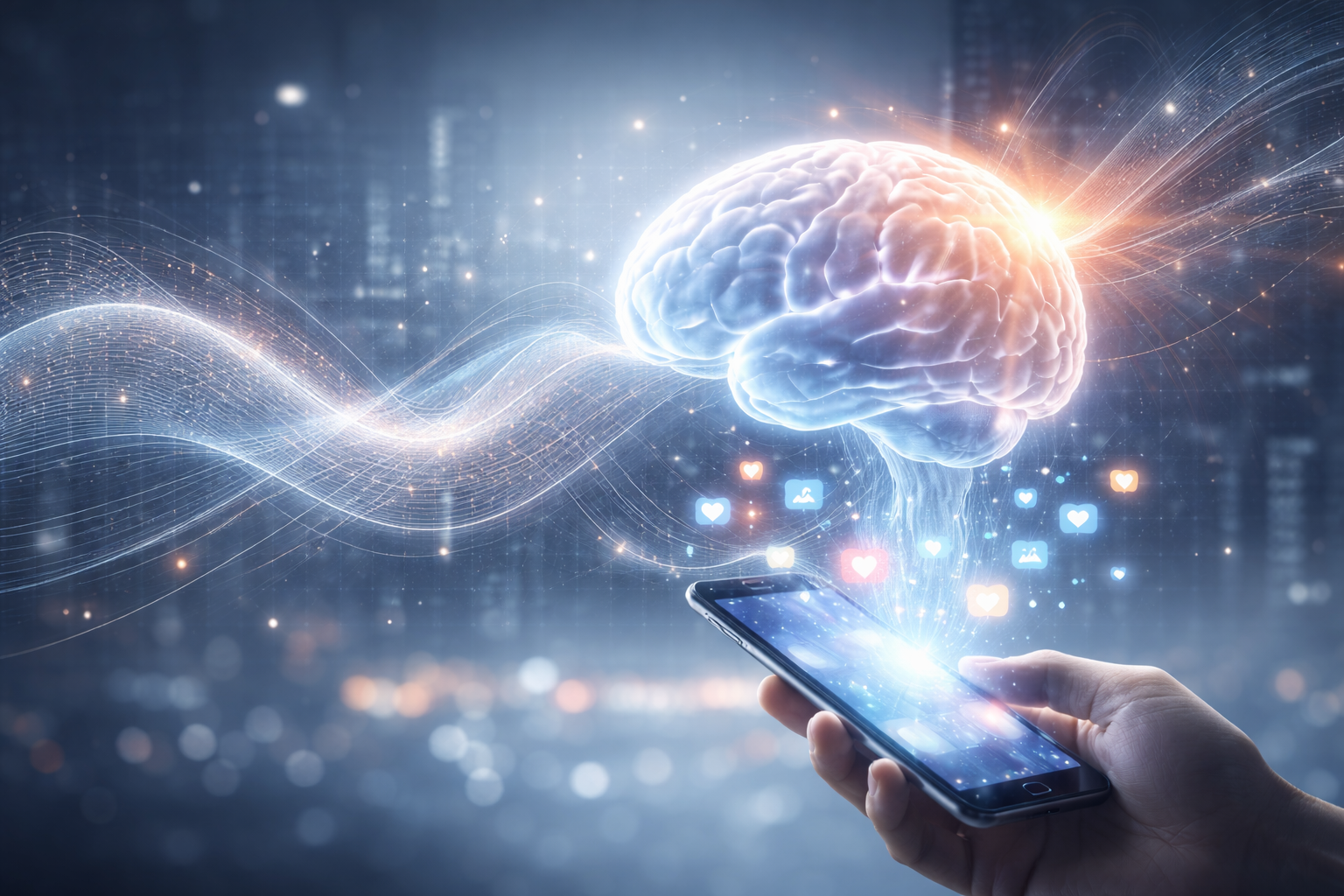
Social media has quietly become the largest behavioral addiction experiment ever conducted.
As of today, more than 5.24 billion people—nearly 64% of the global population—use social media platforms. This is no longer a story about communication or connectivity. It marks a planet-scale neurological shift, unfolding faster than human cognition and biology can reasonably adapt.
Clinical estimates suggest that over 210 million individuals experience symptoms consistent with behavioral addiction to social media. With global usage projected to cross 6 billion users by 2027, digital platforms have effectively become the most pervasive and least regulated dopamine delivery system in history.
This is not cultural drift.
It is neurochemical capture.
What Makes Social Media Addictive?
Social media addiction is not a metaphorical condition. It is rooted in measurable neurobiology.
At its core, social media exploits the brain’s reward-learning machinery—the same circuitry responsible for motivation, habit formation, and addiction. The primary driver of this process is dopamine, a neurotransmitter that signals reward, anticipation, and reinforcement.
Unlike natural rewards, social media delivers dopamine in frequent, unpredictable bursts, conditioning the brain to seek engagement repeatedly. Over time, this transforms casual use into compulsive behavior.
The Dopamine Hijack
In a healthy brain, dopamine operates primarily through tonic firing, maintaining baseline motivation and emotional balance. Social media platforms disrupt this equilibrium by inducing phasic dopamine firing—sharp spikes triggered by likes, notifications, comments, and algorithmically surfaced content.
These spikes predominantly affect:
- The nucleus accumbens
- D₁ dopamine receptor pathways
- The broader mesolimbic reward system
This neurological pattern closely mirrors what is observed in gambling disorder and substance addiction. Each interaction reinforces anticipation rather than satisfaction, creating a persistent loop of seeking behavior with diminishing psychological returns.
Structural Changes in the Brain
Chronic overstimulation is not benign. Repeated dopamine flooding produces observable changes in brain structure and function.
Studies indicate:
- Atrophy in the ventral striatum, a region central to reward processing
- Reduced volume and activity in the prefrontal cortex (PFC)
The prefrontal cortex governs impulse control, emotional regulation, decision-making, and long-term planning. When its activity is diminished, individuals become more susceptible to compulsive behavior and short-term reward seeking.
In adolescents with problematic social media use, dopamine concentrations have been measured at nearly double those of healthy controls:
- 64.86 pg/ml in addicted users
- 36.79 pg/ml in baseline populations
This imbalance reflects reward system dysregulation rather than simple overuse.
Infinite Scroll and Variable Rewards
Social media platforms are not neutral communication tools. They are engineered attention-extraction systems.
Their most powerful mechanism is variable reinforcement—a reward schedule in which outcomes are unpredictable. This uncertainty amplifies engagement far more effectively than consistent rewards, exploiting the brain’s sensitivity to anticipation.
Key design features include:
- Infinite scroll, which removes natural stopping cues
- Algorithmic ranking that escalates emotional intensity
- Social validation loops driven by likes, shares, and comments
Internal research from TikTok identified an “addiction threshold” of approximately 260 videos. At average viewing speeds, users cross this threshold in under 35 minutes.
The hook is fast.
The neurological cost compounds.
Why Children and Adolescents Are Most Vulnerable
The impact of social media addiction is not evenly distributed. It is most severe where the brain is still developing.
Key observations include:
- 70% of teens and young adults self-identify as addicted
- Average daily usage among U.S. teens is 4.8 hours
- Heavy users report up to 9 hours per day, nearly 37% of waking life
Documented mental health outcomes include:
- 63% increase in depression
- 47% rise in anxiety and loneliness
- Significantly elevated suicide risk among teens using social media more than 5 hours daily
Generation Alpha and Early Neural Conditioning
Children aged 8–12 now average 4 hours and 44 minutes of daily screen exposure. This exposure occurs before the prefrontal cortex has fully developed, embedding reward-seeking behaviors into neural architecture during critical developmental windows.
This is not adaptation.
It is neurological front-loading.
The Big Tobacco Parallel
Internal disclosures have eroded the myth of technological neutrality.
- Meta’s internal research confirmed that Instagram worsens body image for one in three teenage girls
- TikTok’s algorithm has been reported to suppress content from users deemed “unattractive” while amplifying conventionally attractive creators
- Age-verification systems remain largely symbolic despite widespread underage usage
These outcomes are not design accidents. They are incentive-aligned consequences of engagement-driven business models.
Reclaiming Digital Autonomy
Escaping algorithmic capture does not require abstinence. It requires structural friction.
Evidence-based countermeasures include:
The Three-Hour Threshold
Mental health outcomes deteriorate sharply beyond three hours of daily social media use.
Friction as Intervention
Disabling push notifications, removing phones from bedrooms, and introducing deliberate access barriers disrupt dopamine cue-reactivity loops.
The Deactivation Cost
Users would require an average payment of $38.83 per month to deactivate social media accounts, revealing the depth of psychological and economic entanglement.
Closing Signal
Social media is the first addictive system that is socially mandatory, globally accessible, and technologically engineered to outpace human evolution.
Reclaiming attention is no longer a productivity preference.
It is a neurological survival strategy.
Human agency depends on it.
FAQ
Is social media addiction a real medical condition?
Social media addiction is classified as a behavioral addiction, not a substance addiction. While it is not formally listed as a standalone diagnosis in most medical manuals, its neurological and behavioral markers closely resemble recognized conditions such as gambling disorder. These include compulsive use, impaired impulse control, withdrawal-like symptoms, and measurable changes in reward circuitry.
How does social media affect dopamine in the brain?
Social media triggers phasic dopamine release, producing sharp reward spikes in response to likes, notifications, and algorithmically curated content. Over time, this disrupts normal dopamine regulation, reducing baseline reward sensitivity and increasing compulsive reward-seeking behavior.
Is social media more addictive than drugs?
Social media does not introduce external chemicals into the body, but its variable reward structure, constant availability, and social reinforcement make it uniquely difficult to disengage from. In terms of population reach and time spent, it is more pervasive than most substances, even if its biochemical mechanism differs.
Why are teenagers and children more vulnerable to social media addiction?
The prefrontal cortex, which governs impulse control and long-term decision-making, continues developing into the mid-20s. Exposure to high-frequency dopamine stimulation during this period increases susceptibility to compulsive behaviors and weakens executive regulation.
What are the mental health effects of excessive social media use?
High levels of social media use are associated with increased rates of depression, anxiety, loneliness, body dissatisfaction, sleep disruption, and suicidal ideation, particularly among adolescents and young adults. These effects intensify as daily usage exceeds several hours.
Can reducing social media use reverse brain changes?
Neuroplasticity allows the brain to recover over time. Reducing usage, introducing friction, and restoring offline reward sources can gradually normalize dopamine sensitivity and improve executive function, though recovery timelines vary by individual.
How much social media use is considered excessive?
Research indicates that mental health outcomes begin to deteriorate significantly beyond three hours of daily use, though individual sensitivity varies. The risk increases sharply with higher duration and compulsive engagement patterns.
Are social media companies aware of these effects?
Internal research disclosures and whistleblower testimony indicate that major platforms are aware of the mental health impacts associated with their products. Despite this knowledge, engagement-optimized design choices have largely remained unchanged.
What is the most effective way to reduce social media addiction?
The most effective interventions introduce structural friction—disabling notifications, removing devices from sleeping spaces, setting time limits, and reducing algorithmic exposure—rather than relying solely on willpower.
Is complete digital detox necessary?
No. The goal is not abstinence but intentional use. Sustainable change comes from reshaping digital environments to support attention, autonomy, and long-term well-being rather than constant stimulation.